


Save time, efficient preparation
Are you still feeling uncomfortable about giving up a lot of time to entertain, work or accompany your family and friends in preparation for the exam? Using DSA-C03 quiz torrent, you can spend less time and effort reviewing and preparing, which will help you save a lot of time and energy. Whether you are a worker or student, you will save much time to do something whatever you want. It only needs 5-10 minutes after you pay for our DSA-C03 learn torrent that you can learn it to prepare for your exam. Actually, if you can guarantee that your effective learning time with DSA-C03 test preps are up to 20-30 hours, you can pass the exam.
Free trial download
Are you often regretful that you have purchased an inappropriate product? Unlike other platforms for selling test materials, in order to make you more aware of your needs, DSA-C03 test preps provide sample questions for you to download for free. You can use the sample questions to learn some of the topics about DSA-C03 learn torrent and familiarize yourself with the DSA-C03 quiz torrent in advance. If you feel that the DSA-C03 quiz torrent is satisfying to you, you can choose to purchase our complete question bank. After the payment, you will receive the email sent by the system within 5-10 minutes. Click on the login to start learning immediately with DSA-C03 test preps. No need to wait.
Practice online anytime
The online version of DSA-C03 quiz torrent is based on web browser usage design and can be used by any browser device. The first time you use DSA-C03 test preps on the Internet, you can use it offline next time. DSA-C03 learn torrent does not need to be used in a Wi-Fi environment, and it will not consume your traffic costs. You can practice with DSA-C03 quiz torrent at anytime, anywhere. On the other hand, the online version has a timed and simulated exam function. You can adjust the speed and keep vigilant by setting a timer for the simulation test. At the same time online version of DSA-C03 test preps also provides online error correction— through the statistical reporting function, it will help you find the weak links and deal with them. Of course, you can also choose two other versions. The contents of the three different versions of DSA-C03 learn torrent is the same and all of them are not limited to the number of people/devices used at the same time.
The DSA-C03 examination time is approaching. Faced with a lot of learning content, you may be confused and do not know where to start. DSA-C03 test preps simplify the complex concepts and add examples, simulations, and diagrams to explain anything that may be difficult to understand. You can more easily master and simplify important test sites with DSA-C03 learn torrent. In addition, please be assured that we will stand firmly by every warrior who will pass the exam. DSA-C03 quiz torrent has the following characteristics:

Snowflake DSA-C03 Exam Syllabus Topics:
| Section | Weight | Objectives |
|---|---|---|
| Topic 1: Snowflake Data Science Best Practices | 15%–20% | - Performance Optimization
|
| Topic 2: Data Science Concepts | 10%–15% | - Machine Learning Concepts
|
| Topic 3: Data Preparation and Feature Engineering | 25%–30% | - Data Preparation
|
| Topic 4: Model Development and Machine Learning | 25%–30% | - Model Evaluation
|
| Topic 5: Generative AI and LLM Capabilities | 10%–15% | - GenAI in Snowflake
|
Snowflake SnowPro Advanced: Data Scientist Certification Sample Questions:
You are building a data science pipeline in Snowflake to predict customer churn. The pipeline includes a Python UDF that uses a pre- trained scikit-learn model stored as a binary file in a Snowflake stage. The UDF needs to load this model for prediction. You've encountered an issue where the UDF intermittently fails, seemingly related to resource limits when multiple concurrent queries invoke the UDF. Which of the following strategies would best optimize the UDF for concurrency and resource efficiency, minimizing the risk of failure?
- A. Utilize Snowflake's session-level caching by storing the loaded model in 'session.get('model')' to be reused across multiple UDF calls within the same session. Reload the model if 'session.get('model')' is None.
- B. Increase the memory allocated to the Snowflake warehouse to accommodate multiple UDF invocations.
- C. Implement a global, lazy-loaded cache for the scikit-learn model within the UDF's module. The model is loaded only once during the first invocation and shared across subsequent calls. Protect the loading process with a lock to prevent race conditions in concurrent environments.
- D. Load the scikit-learn model outside the UDF function in the global scope of the module so that all invocations share the same loaded model instance. Use the 'context.getExecutionContext(Y to track execution, making sure it is thread safe.
- E. Load the scikit-learn model inside the UDF function on every invocation to ensure the latest version is used.
Correct Answer: C 🗳️
Explanation: Only visible for TestInsides members. You can sign-up / login (it's free).
You are building a fraud detection model using Snowflake data'. The dataset 'TRANSACTIONS' contains billions of records and is partitioned by 'TRANSACTION DATE'. You want to use cross-validation to evaluate your model's performance on different subsets of the data and ensure temporal separation of training and validation sets. Given the following Snowflake table structure: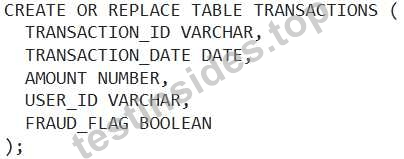
Which approach would be MOST appropriate for implementing time-based cross-validation within Snowflake to avoid data leakage and ensure robust model evaluation? (Assume using Snowpark Python to develop)
- A. Create a UDF that assigns each row to a fold based on the 'TRANSACTION DATE column using a modulo operation. This is then passed to the 'cross_validation' function in Snowpark ML.
- B. Implement a custom splitting function within Snowpark, creating sequential folds based on the 'TRANSACTION DATE column and use that with Snowpark ML's cross_validation. Ensure each fold represents a distinct time window without overlap.
- C. Explicitly define training and validation sets based on date ranges within the Snowpark Python environment, performing iterative training and evaluation within the client environment before deploying a model to Snowflake. No built-in cross-validation used
- D. Use 'SNOWFLAKE.ML.MODEL REGISTRY.CREATE MODEL' with default settings, which automatically handles temporal partitioning based on the insertion timestamp of the data.
- E. Utilize the 'SNOWFLAKE.ML.MODEL REGISTRY.CREATE MODEL' with the 'input_colS argument containing 'TRANSACTION DATE'. Snowflake will automatically infer the temporal nature of the data and perform time-based cross-validation.
Correct Answer: B 🗳️
Explanation: Only visible for TestInsides members. You can sign-up / login (it's free).
A data scientist needs to analyze website session data stored in a Snowflake table named 'WEB SESSIONS'. The table contains columns like 'SESSION D', 'USER_ID, 'PAGE_VIEWS', 'TIME SPENT_SECONDS', and 'TIMESTAMP. They want to identify potential bot traffic by analyzing the correlation between 'PAGE VIEWS' and 'TIME SPENT SECONDS'. Which of the following Snowflake SQL queries is the MOST efficient and statistically sound way to calculate the Pearson correlation coefficient between these two columns, handling potential NULL values appropriately?
- A. Option D
- B. Option E
- C. Option C
- D. Option A
- E. Option B
Correct Answer: A 🗳️
Explanation: Only visible for TestInsides members. You can sign-up / login (it's free).
You are developing a model to predict equipment failure in a factory using sensor data stored in Snowflake. The data is partitioned by 'EQUIPMENT ID' and 'TIMESTAMP. After initial model training and cross-validation using the following code snippet: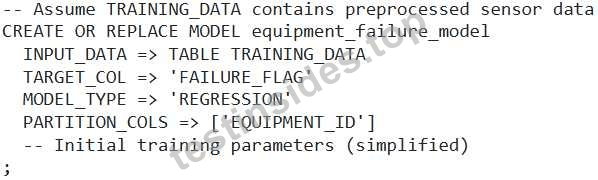
You observe significant performance variations across different equipment groups when evaluating on out-of-sample data'. Which of the following strategies could you employ to address this issue within the Snowflake environment to improve the model's generalization ability across all equipment?
- A. Increase the overall size of the "TRAINING_DATR to include more historical data for all equipment, assuming this will balance the representation of each EQUIPMENT ID'
- B. Implement cross-validation at the partition level by splitting 'TRAINING_DATX into train and test sets before creating the model, and then using the 'FIT' command to train on the train set and 'PREDICT to evaluate on the test set, repeating for each partition.
- C. Retrain the model with additional feature engineering to create interaction terms between 'EQUIPMENT_ID' and other relevant sensor features to capture equipment-specific patterns. For instance, you can one hot encode and add to model and include in 'INPUT DATA'.
- D. Implement a hyperparameter search using 'SYSTEM$OPTIMIZE_MODEL' with a wider range of parameters for each 'EQUIPMENT_ID individually, creating a separate model for each 'EQUIPMENT ID.
- E. Create seperate models per equipment ID. For each equipment ID, split data into training and testing data. For each equipment ID, use 'SYSTEM$OPTIMIZE MODEL' to perform hyper parameter search individually. Train and Deploy the model at equipement ID Level.
Correct Answer: C,E 🗳️
Explanation: Only visible for TestInsides members. You can sign-up / login (it's free).
A data scientist is analyzing website conversion rates for an e-commerce platform. They want to estimate the true conversion rate with 95% confidence. They have collected data on 10,000 website visitors, and found that 500 of them made a purchase. Given this information, and assuming a normal approximation for the binomial distribution (appropriate due to the large sample size), which of the following Python code snippets using scipy correctly calculates the 95% confidence interval for the conversion rate? (Assume standard imports like 'import scipy.stats as St' and 'import numpy as np').
- A.

- B.
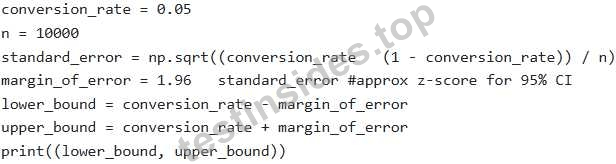
- C.

- D.

- E.

Correct Answer: B,C 🗳️
Explanation: Only visible for TestInsides members. You can sign-up / login (it's free).
Viewing page 1 out of 58 pages.
Viewing questions 1-5 out of 289 questions.


 Jennifer

 Setlla

 Stanford
 Lorraine
 Bevis
 Tracy

 Michaelia
 Steven
 Walker
 Arnold
 Mandel
 Glenn
 Ophelia
 Kerwin
 Zora
 Natalie
 Bridget
 Xenia
 Kim


