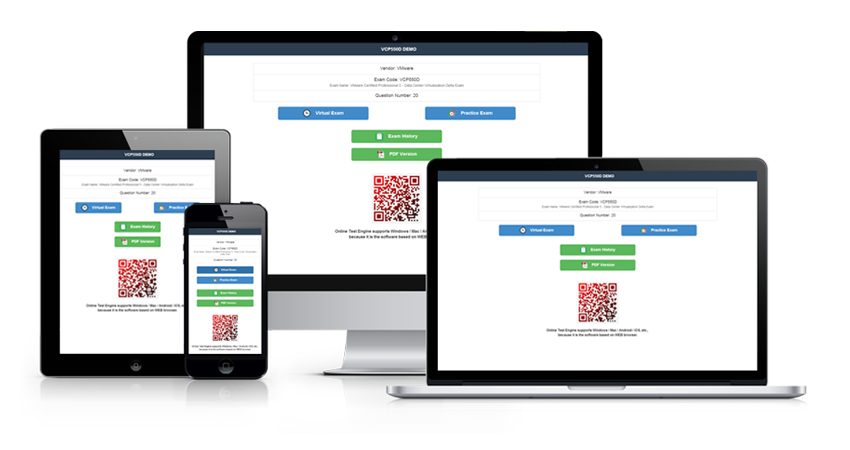
Three versions available
One of the biggest highlights of the AWS Certified Advanced Networking Specialty (ANS-C00) Exam (AWS-Advanced-Networking-Specialty Korean Version) prep torrent is the availability of three versions: PDF, app/online, and software/pc, each with its own advantages: The PDF version of AWS-Advanced-Networking-Specialty Korean exam torrent has a free demo available for download. You can print exam materials out and read it just like you read a paper. The online version of AWS-Advanced-Networking-Specialty Korean test guide is based on web browser usage design and can be used by any browser device. At the same time, the first time it is opened on the Internet, it can be used offline next time. You can practice anytime, anywhere. The AWS Certified Advanced Networking Specialty (ANS-C00) Exam (AWS-Advanced-Networking-Specialty Korean Version) software supports the MS operating system and can simulate the real test environment. The contents of the three versions are the same. Each of them neither limits the number of devices used or the number of users at the same time. You can choose according to your needs.
Customer privacy protection
In this age of the Internet, do you worry about receiving harassment of spam messages after you purchase a product, or discover that your product purchases or personal information are illegally used by other businesses? Please do not worry; we will always put the interests of customers in the first place, so AWS-Advanced-Networking-Specialty Korean test guide ensure that your information will not be leaked to any third party. After you pass the exam, if you want to cancel your account, contact us by email and we will delete all your relevant information. Second, the purchase process of AWS Certified Advanced Networking Specialty (ANS-C00) Exam (AWS-Advanced-Networking-Specialty Korean Version) prep torrent is very safe and transactions are conducted through the most reliable guarantee platform.
Exam Topics for AWS Certified Advanced Networking - Specialty
The following will be discussed in AMAZON ADVANCED-NETWORKING-SPECIALITY exam dumps:
- Manage, Optimize, and Troubleshoot the Network
- Design and Implement AWS Networks
- Automate AWS Tasks
- Design and Implement for Security and Compliance
- Configure Network Integration with Application Services
- Design and Implement Hybrid IT Network Architectures at Scale
When some candidates trying to overcome an exam, they will all first think of choosing a good study material to prepare for their exam. The AWS Certified Advanced Networking Specialty (ANS-C00) Exam (AWS-Advanced-Networking-Specialty Korean Version) prep torrent has a variety of self-learning and self-assessment functions to test learning outcome, which will help you increase confidence to pass exam. Last but not least, our website platform has no viruses and you can download AWS-Advanced-Networking-Specialty Korean test guide at ease. If you encounter difficulties in installation or use of AWS-Advanced-Networking-Specialty Korean exam torrent, we will provide you with remote assistance from a dedicated expert to help you and provide 365 days of free updates that you do not have to worry about what you missed.

AWS Advanced Networking Specialty Exam Syllabus Topics:
| Section | Objectives |
|---|---|
Design and implement hybrid IT network architectures at scale - 24% | |
| Apply procedural concepts for the implementation of connectivity for hybrid IT architecture | |
| Given a scenario, derive an appropriate hybrid IT architecture connectivity solution | - Determine IP address allocations for a low-level design - Map the application flows to create a communication matrix - Implement device configurations based on templates - Determine implementation steps for the configuration of the AWS console (AWS, Direct Connect link, VPN, On-premises, L1→7 testing, etc.) - Integrate AWS and on-premises DNS services - Outline the components of a solution (for example, diagram, protocols within a solution, VLANs, 801.q, BFD, etc.) - Evaluate a network architecture diagram for alignment to business and technical requirements - Determine implementation steps for the configuration of devices (AWS, Direct Connect link, VPN, On-premises, L1→7 testing, etc.) - Customize device configurations based on business requirements - Given business and technical requirements, define a rollback procedure - Design multipath links into the VPC to meet business requirements - Determine the high availability/load balancing requirements specific to an architecture |
| Explain the process to extend connectivity using Direct Connect | |
| Evaluate design alternatives leveraging Direct Connect | - Determine the appropriate region(s) to use in support of private VIFs - Determine the appropriate resiliency strategy - Determine whether customer device colocation at the DX facility is required - Restrict public VIF access to specific regional services - Determine whether multiple sub-1G connections are required - Determine Direct Connect facilities required to provide connection redundancy - Route Direct Connect traffic to multiple AWS regions with a Direct Connect gateway |
| Define routing policies for hybrid IT architectures | - Determine a routing policy according to customer requirements concerning high availability, load balancing, traffic shaping, and security - Define link parameters for the routing peers (AWS router peering with an on-premises router) - Define BGP parameters that will be required to implement the routing policy (for example, BGP metrics, AS number) - Implement device-based configuration for route manipulation outside the routing protocol configurations (route filtering, route maps, policy based routing, ACL’s, AS manipulations) in order to implement the routing policy - Determine a testing plan - Create router configurations (including BGP configuration, policy/security configurations) - Test the implementation |
Design and implement AWS networks - 28% | |
| Apply AWS networking concepts | |
| Given customer requirements, define network architectures on AWS | - Explain the purpose and functionality of AWS software-defined networking - Describe how network isolation within AWS works (VPC) and its various components - Calculate the number of IP addresses required - Calculate the number of networks/subnets required and the number of hosts within each network - Classify the level of isolation between subnets - Explain the traffic flow requirements between subnets and in/out of VPC - Outline the requirements of global networks and communication between them - Create VPC, subnets, route tables, and Network ACLs using the AWS console or AWS tools according to customer requirements - Create and attach gateways - Leverage VPC endpoints to meet customer requirements - Design an IP addressing scheme based on the customer requirements and estimate the subnet size (subnet masks) for each subnet - Differentiate the subnets into various logical units based on customer requirements (security isolation, dev/test/prod environment, etc.) - Design a security model for each subnet (Network ACL, public/private subnet) - Determine the routing characteristics for each subnet - Design a model for connecting a VPC to the public internet (if required) and the security around that based on customer requirements - Design a model for inter-VPC communication (within a region/global) and the security around that based on customer requirements, including AWS Transit Gateway - Select ecosystem solutions that augment AWS services and address customer requirements - Determine if a subnet should be shared with multiple AWS accounts |
| Propose optimized designs based on the evaluation of an existing implementation | - Map best practice for particular product sets used and identified in HLD or account usage with best practice identified from whitepapers and other AWS reference documentation (for example, using GAP analysis between current deployment and AWS best practices) - Make recommendations around differences between current deployment identified in HLD and AWS best practices - Determine and carry out a change management plan based upon target architecture - Determine an appropriate network optimization strategy (for example, placement groups, enhanced networking, additional ENI, ENA, EFA, ecosystem, EBS Optimized, MTU, throughput to the internet) - Use tools including, GAP Analyses, AWS Reference architectures, AWS whitepapers, AWS Documentation for specific products |
| Determine network requirements for a specialized workload | - Determine specialized workload(s) and its network requirements (for example, bandwidth requirement, latency requirement, reliability/resiliency requirement, encryption requirements) - Outline components of the solution (for example, diagram, protocols within a solution, VLANs, 801.q, BFD, etc.) |
| Derive an appropriate architecture based on customer and application requirements | - Map business and application requirements to technical solution - Determine application requirements and translate to technical requirements - Evaluate customer business requirements and compare them to application requirements, mapping differences - Map application flow requirements to network capabilities - Outline a requirements definition document detailing mapped customer requirements to application requirements within the network limitations of the system - Translate customer requirements into AWS components |
| Evaluate and optimize cost allocations given a network design and application data flow | - Estimate charges based on network design - Estimate charges based on the application data flow (for example, VPC-E, AWS Key Management Service (AMS KMS) snapshot copy, Amazon S3 cross-region-replication, interAvailability Zone, etc.) |
Automate AWS tasks - 8% | |
| Evaluate automation alternatives within AWS for network deployments | - Manage VPC infrastructure using AWS CloudFormation - Extend network provisioning self-service using AWS Service Catalog - Store Infrastructure-as-Code artifacts in AWS CodeCommit - Audit changes using AWS Config, Amazon Single Notification Service (Amazon SNS), AWS Lambda, and CloudFormation drift detection - Implement overlay network configurations dynamically using Amazon EC2 tags (e.g., multicast), Transit Gateway to route multicast traffic between subnets of attached VPCs - Leverage Lambda as a CloudFormation custom resource for integration with external systems, including IPAM software - Build CloudFormation templates using CloudFormation |
| Evaluate tool-based alternatives within AWS for network operations and management | - Use scripting (any language) to implement highly available solutions for NAT, firewalls, etc., on EC2 - Use APIs to interrogate current network component status/configuration - Implement EC2 monitoring scripts for Amazon CloudWatch and Amazon CloudWatch Logs - Use the Network Manager console to visualize and monitor the global network - Use VPC traffic mirroring to monitor traffic - Given a customer scenario, utilize CloudWatch to monitor for aggregated metrics and issue notifications and automated fixes |
Configure network integration with application services - 14% | |
| Leverage the capabilities of Amazon Route 53 | |
| Evaluate DNS solutions in a hybrid IT architecture | - Leverage Route 53 aliases with other AWS services. - Select appropriate DNS record types, values, and TTLs - Based on customer requirements, determine the appropriate DNS zone type (public/private) - Describe the differences between public and private hosted zones - Given business requirements, design an appropriate DNS routing strategy - Design and configure a hierarchy of hosted zones and record sets - Given business requirements, design an effective health check strategy |
| Determine the appropriate configuration of DHCP within AWS | - Explain key concepts and functionality of DHCP - Describe how DHCP works in AWS (for example, layer 2 broadcast) - Determine appropriate use of DHCP for assignment of IP addresses (for example, secondary IPs) - Configure DHCP option-sets to meet application requirements - Implement solutions where linked applications require different DHCP option-sets |
| Given a scenario, determine an appropriate load balancing strategy within the AWS ecosystem | - Implement sticky sessions - Identify strategies for retrieving client IP addresses - Configure load balancing of TCP, HTTP, and HTTPS services - Given business and application requirements, design an application health check strategy - Leverage ecosystem (for example, Elastic Load Balancers and third-party solutions) offerings to meet application requirements - Given a scenario, identify an appropriate load balancing solution |
| Determine a content distribution strategy to optimize for performance | - Identify and map the end-to-end content flows to create a communication matrix - Identify and map the end-to-end DNS flows to create a communication matrix - Given a scenario, determine the appropriate Amazon CloudFront solution (URLs, protocols [HTTP and/or HTTPS], methods) - Determine implementation steps for CloudFront, origin server, and related services – Route 53 (or AWS Global Accelerator where more appropriate), EC2, S3, AWS Direct Connect, etc. - using the AWS console. - Determine measurement methodologies to ensure alignment to business requirements |
| Reconcile AWS service requirements with network requirements | - Determine how an AWS service communicates over the network (protocols, ports, etc.) - Design the data flow model from an AWS service to the rest of the in-scope components (within AWS service, public internet) - Determine how the application interacts with an AWS service and design the network communication flow between them - Determine the CIDR requirements for an AWS service (if any) - Build the network security model for an AWS service |
Design and implement for security and compliance - 12% | |
| Evaluate design requirements for alignment with security and compliance objectives | - Given security requirements, select appropriate AWS tools and eco-system - Implement an isolated subnet architecture - Design and implement an AWS network architecture to meet security and compliance requirements (for example, a demilitarized zone (DMZ), three tier) - Develop a threat model and identify an appropriate mitigation strategy for a given implementation - Identify security vulnerabilities and/or compliance violations in a given scenario |
| Evaluate monitoring strategies in support of security and compliance objectives | - Create and interact with a VPC flow log - Use AWS CloudTrail for monitoring attempted/completed networking resource changes - Implement automated alarms using CloudWatch - Implement customized metrics using CloudWatch - Determine an overall security/monitoring solution based on customer business requirements - Analyze administration and security tools (for example, CloudTrail, CloudWatch, instance logs, cmdb) for authorized changes (potentially on InfoSec side) |
| Evaluate AWS security features for managing network traffic | - Contrast and compare functional capabilities of security groups, Network ACLs, and IAM policies - Determine the network security requirements for the application - Determine and map the application flows to create policy enforcement objects (security groups, Network ACLs, or IAM policies) - Determine the appropriate application of security groups versus Network ACLs, versus IAM policies - Implement security groups, Network ACLs, and IAM policies according to the security requirements (for example. restrict who can make changes to networking resources including VPCs, subnets, routing tables, security groups, Network ACLs, VGW, IGW, etc.) - Test compliance with the stated requirements - Outline the network security solution (for example, diagram, protocols allowed/denied through security groups, Network ACLs, permissions matrix for allowed/denied actions on networking resources) - Customize implementation based on business requirements |
| Utilize encryption technologies to secure network communications | - Determine the applicable compliance requirements for encryption - Determine what application data needs to be encrypted - Determine the data flow and systems that will store that data - Implement pertinent encryption solution(s) to encrypt data in transit and data at rest (S3, Amazon Elastic Block Store (Amazon EBS), Amazon Relational Database Solution (Amazon RDS), and custom solutions on EC2) - Implement the encryption key management solution (using AWS Key Management Service (AWS KMS) or a customer owned third-party solution) - Implement auditing of access to encrypted data - Test to verify compliance - Outline the components of the solution (encryption, key management, audit controls etc.) - Identify any application performance impact due to encryption and recommend a mitigating solution |
Manage, optimize, and troubleshoot the network - 14% | |
| Given a scenario, troubleshoot and resolve a network issue | - Review route tables to locate black holes or lack of route propagation - Interrogate on-premises devices (VPN or Direct Connect) to identify network reachability - Validate L1-L4 reachability and investigate potential cause of failure at each layer - Given standard diagnostic information, identify implementation errors or faults in the AWS network configuration - Assess appropriate use of security groups and Network ACLs (permit compared to deny) - Use VPC flow logs to locate configuration errors or potential security holes in security groups or Network ACLs |
Reference: https://aws.amazon.com/certification/certified-advanced-networking-specialty/
Guaranteed agreement
In addition to the free download of sample questions, we are also confident that candidates who use AWS-Advanced-Networking-Specialty Korean test guide will pass the exam at one go. AWS Certified Advanced Networking Specialty (ANS-C00) Exam (AWS-Advanced-Networking-Specialty Korean Version) prep torrent is revised and updated according to the latest changes in the syllabus and the latest developments in theory and practice. Regardless of your weak foundation or rich experience, AWS-Advanced-Networking-Specialty Korean exam torrent can bring you unexpected results. In the past, our passing rate has remained at 99%-100%. This is the most important reason why most candidates choose AWS-Advanced-Networking-Specialty Korean test guide. Failure to pass the exam will result in a full refund. But as long as you want to continue to take the AWS Certified Advanced Networking Specialty (ANS-C00) Exam (AWS-Advanced-Networking-Specialty Korean Version) exam, we will not stop helping you until you win and pass the certification.